
Woodworking Tools for Beginners: Five to Start With (and the Ones You Can Skip)
You need five tools to start woodworking: a tape measure and a square, a cordless drill/driver, a circular saw (or a sharp handsaw), four clamps, and a random-orbit sander. That list will build a planter box, a shelf, a bench or a cutting board. Everything else can wait until a project tells you what you're missing.
Most beginner tool lists are written to sell you fifteen things. You need about five, and two of them you probably already own.
I've been doing this for thirty years, and I still use a tape measure more than any machine in the building. That's the part nobody tells you when you're starting out: the tools that actually build things are boring, and the ones in the catalog photos mostly sit there looking expensive. So here's the honest version.
Start with these five
Every one of these earns its place because it does something no other tool on the list can do. That's the whole test.
- A tape measure and a square. These two are the foundation, and they're the cheapest things here. The tape tells you how long, the square tells you whether it's true. If your parts aren't cut square, nothing you build will sit flat — no amount of clamping fixes a crooked cut.
- A cordless drill/driver. Drills holes, drives screws, and on a beginner project that's most of the assembly right there. One decent 18-volt drill with a set of bits will do years of work.
- A circular saw. Paired with a straight board to guide it, it'll break down sheet goods and crosscut lumber accurately enough for anything you build in the first year. A sharp handsaw works too, and it's quieter.
- Clamps — at least four. Clamps are the extra set of hands you don't have. They hold parts while glue dries and hold work still while you cut. Everybody buys too few.
- A random-orbit sander. Sanding by hand is fine for small pieces and miserable for anything bigger. This is the one power tool that turns a chore you'd avoid into one you'll finish.
That's a real shop. Those five and a scrap of plywood to work on will take you further than most people get with a garage full of machines.
The ones you can skip for now
This is the part the tool lists leave out, so let me be straight with you. These are all good machines. I own them and use them daily. You don't need any of them yet.
- A table saw. The one everybody thinks is the price of entry. It isn't. A circular saw and a straight edge cut the same parts for a fraction of the cost and don't eat half your garage.
- A planer and a jointer. These flatten and square rough lumber. Buy boards already surfaced at the yard — and starting out, you should — and that job's done for you.
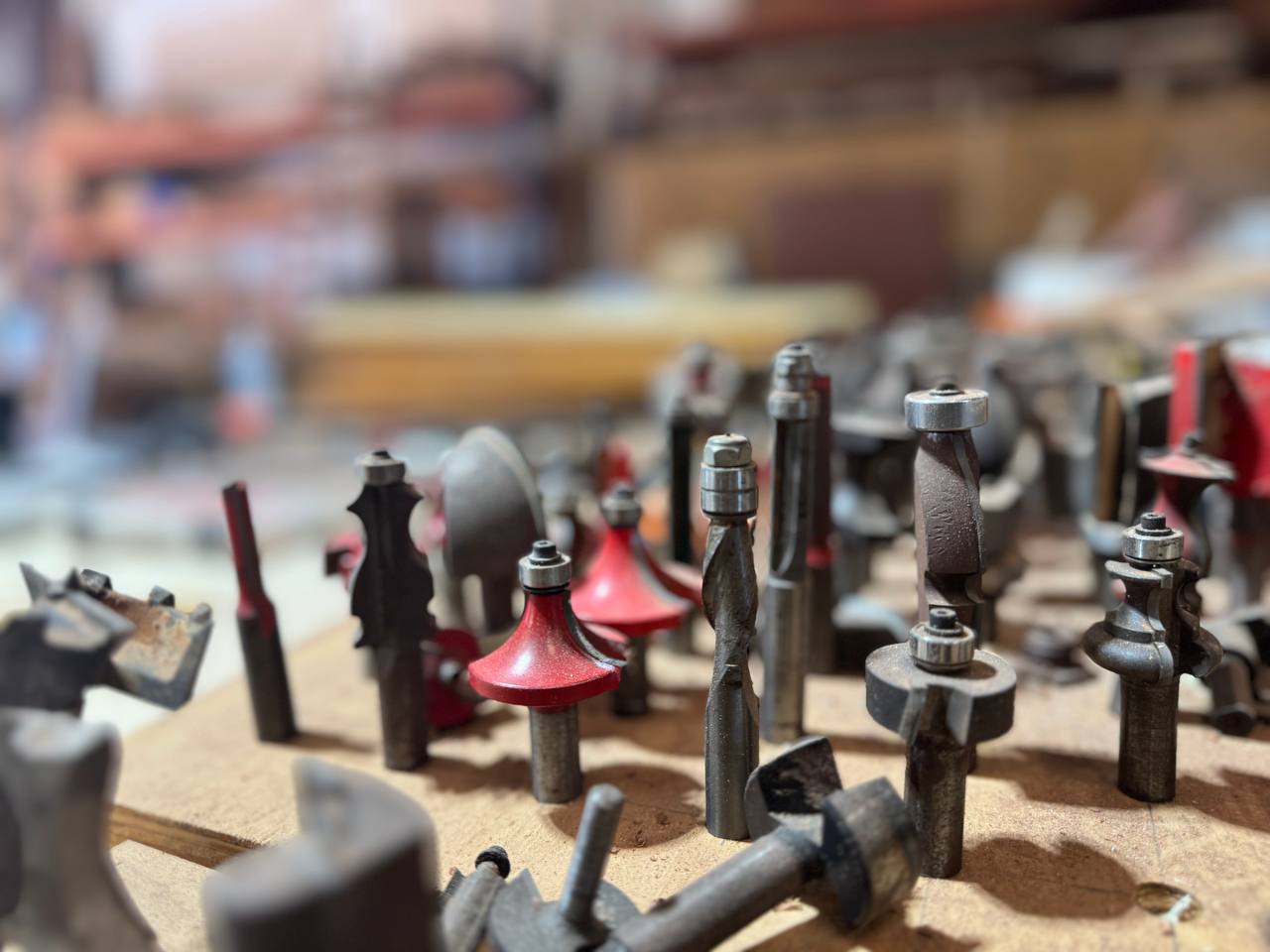
- A router. Useful, versatile, and genuinely not necessary for a box with four sides. Those bits in the photo up top are a working shop's collection built over decades, not a starter kit.
- A miter saw. Lovely for repetitive crosscuts. Your circular saw already crosscuts.
- Dust collection and a full bench. Worth real money later. A shop vac and plywood on sawhorses is where nearly everybody starts, including me.
Here's my actual rule: buy the machine when the work you're already doing keeps asking for it. If you've cut the same joint forty times and your arms hurt, that's the machine telling you it's time. Buying first and hoping the projects show up is how garages fill with dusty equipment.
Buy used where it makes sense
Some tools are a bargain secondhand and some are a gamble. The line is simpler than you'd think: if the tool is mostly steel and iron, buy it used. If it depends on electronics, a battery or a sealed motor, buy it new.
Worth hunting at estate sales, flea markets and online listings:
- Clamps. They almost never wear out. Old ones are often built better than new ones.
- Hand planes and chisels. Surface rust looks alarming and cleans off. Good steel is good steel, and a lot of it was made fifty years ago.
- Squares and marking tools — but check them against a known square edge before you hand over money. A square that isn't square is worse than no square at all.
- Cast-iron machines. The heavy old ones were built to be repaired, and parts are usually still out there.
Buy new instead: anything cordless, because batteries fade and old packs are often orphaned; and your safety gear — glasses, hearing protection, a dust mask. That's not the place to save.
One more: buy new blades and new sandpaper no matter where the tool came from. Which brings me to the real point.
The cheap thing that matters more than any tool
If you take one thing from this, take this one. Sharp blades and accurate measuring will do more for your work than any upgrade you can buy.
A dull blade burns the wood, wanders off your line, kicks back, and makes you push harder — which is worse work and the dangerous way to work. People blame the saw. It's almost never the saw. A fresh blade in a modest tool beats a worn blade in an expensive one, every time.
Same with measuring. Use one tape for the whole project — tapes disagree with each other by a hair, and those hairs add up. Mark with a sharp pencil or a knife, not a fat crayon. Cut to the line, not near it. None of that costs a thing, and it's the difference between a box that closes and a box that doesn't.
What "good enough" actually looks like
Nobody needs shop-grade gear to build a planter box. I want to say that plainly, because a lot of beginners stall out waiting until they can afford a "real" setup.
A planter box lives outside and holds dirt. A garage shelf holds paint cans. These need to be square, solid and sealed — they don't need to be heirlooms, and the tolerance is looser than the internet will have you believe. Build the simple thing with the five tools. Finish it. Put it outside and look at it for a season. You'll learn more from that than from six months of research.
If you want somewhere to start, there are step-by-step beginner builds over on From the Bench — a cedar planter box and a floating shelf are both good first projects that need nothing beyond the five tools above.
Start small. Buy slowly. Keep the blades sharp.
Common questions
What tools do I need to start woodworking?
Five: a tape measure and square, a cordless drill/driver, a circular saw or sharp handsaw, four clamps, and a random-orbit sander. That covers measuring, cutting, joining, holding and finishing — which is every step of a beginner project. Add tools when a project shows you what's missing.
Do I need a table saw to start woodworking?
No. Most beginners buy one far too early. A circular saw guided by a straight edge cuts everything a starter project needs, costs much less, and leans against a wall when you're done. Buy the big machine when your actual work keeps asking for it.
Which woodworking tools are worth buying used?
Clamps, hand planes, chisels, squares and old cast-iron machines — the parts that matter are steel and iron and they don't wear out. Buy new when the tool depends on a battery, electronics or a sealed motor. Always check a used square for accuracy before you buy it.
How much should a beginner spend on woodworking tools?
Less than most lists suggest. Spend on good measuring tools and fresh blades, buy mid-range versions of the five essentials, and let real projects tell you where to upgrade. The most expensive tool in any shop is the one that never gets used.
Some things are worth building yourself. Some are worth having built.
Building your own is satisfying, and we'd encourage anybody to start. When it's a custom door, gate or piece you want done right the first time, that's what we're here for — handcrafted in Ravenel, South Carolina.
Request a Custom Piece More from the bench →