
Screen Door vs. Storm Door: Which One Does Your Home Actually Need?
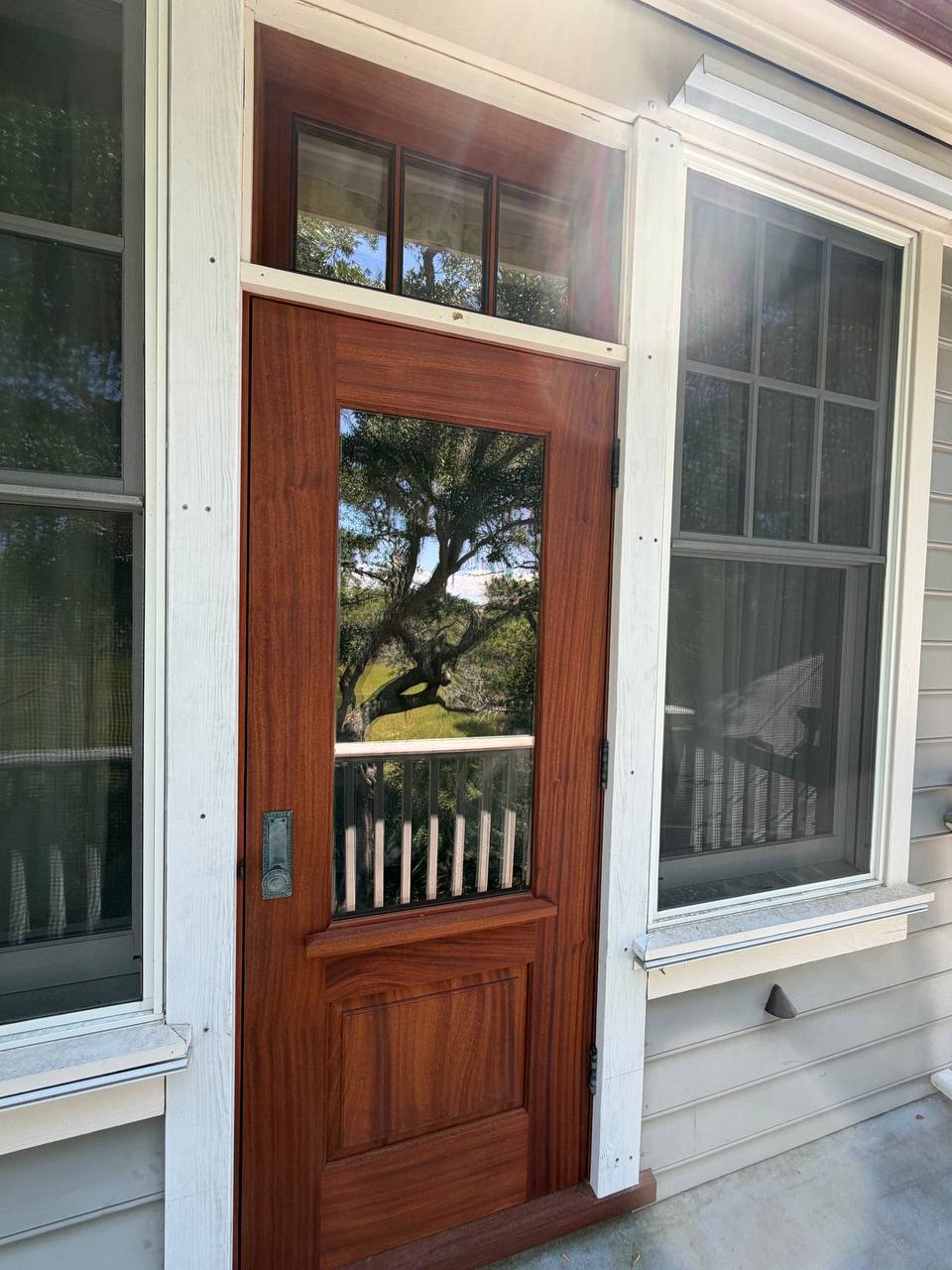
A screen door has mesh and is built to let air in. A storm door has glass and is built to keep weather out. If you live somewhere with long cold winters, a storm door pays for itself. If you live where summers are hot and winters are short — like most of the Lowcountry — a screen door is almost always the better door, and it's the one you'll actually use.
People ask me this one more than anything else. They look nearly the same hanging in the opening, and they do close to opposite jobs.
I've built a lot of doors, and I've watched a lot of folks buy the wrong one. It's an easy mistake — walk into any home center and screen doors and storm doors sit in the same aisle under the same sign. But they're solving two different problems. Let me lay it out the way I'd explain it to somebody standing in the shop.
The real difference in one sentence
A storm door has a glass panel. A screen door has screen mesh. That's it — everything else follows from that.
Glass blocks air. Mesh passes air. So a storm door adds a sealed layer in front of your entry door and cuts down drafts and heat loss. A screen door adds an open layer that lets you leave the front door standing wide open without letting in every bug in the county. One is about insulation, the other is about ventilation. They're not competing versions of the same product.
Plenty of storm doors are sold as convertible — a glass panel you swap out for a screen panel when the weather turns. That sounds like the best of both worlds on the showroom floor. In practice most people swap it once, decide it's a nuisance, and leave it however it landed. I'd rather you buy the door you'll actually use year-round than the one with the most features.
What a storm door is really for
A storm door earns its money in a cold climate. Up north it does real work:
- Adds an insulating air pocket in front of your entry door, which knocks down drafts and trims the heating bill over a long winter
- Shields the entry door from snow, ice, and driving rain
- Gives you a second lockable barrier at the front of the house
Where winters run five or six months, that adds up. That's why storm doors are standard equipment in the Midwest and the Northeast.
What a screen door is really for
A screen door does something a storm door can't: it lets you open your house. On a good spring evening or a cool fall morning, you swing the front door in, and the breeze moves through while the bugs stay outside. Here's what you get:
- Real airflow. Cross-ventilation through the house means fewer hours of running the air conditioner in shoulder season
- Bug control without shutting the house up — the whole reason screen doors exist in the South
- Sun protection for your entry door. The screen door takes the UV and the blowing rain first, which stretches out the life of the finish behind it
- Curb appeal. A well-made screen door is the first thing anybody sees walking up. It sets the tone for the whole front of the house
Why a screen door usually wins in the Lowcountry
Charleston isn't Chicago. Our summers are long and hot, our winters are short and mild, and the shoulder seasons are genuinely beautiful. That changes the math completely.
- The insulation payback isn't there. A storm door's energy savings come from cold months. We don't have enough of them for it to matter much
- Glass and afternoon sun are a bad pair. A storm door on a west- or south-facing entry can trap serious heat in the gap between the two doors. That heat sits against your entry door all afternoon and works on the finish. I've seen it cook a good door
- Ventilation is the actual need here. Every month you can open the house is a month you're not running the AC
- Salt air is hard on cheap hardware. Near the water, thin aluminum frames, light-duty closers, and plated hardware corrode fast. What you buy matters more than what type it is
For most homes in Charleston, Mount Pleasant, Johns Island, and out our way in Ravenel, the screen door is the one that gets used every week of the year. That's why it's most of what we build.
When a storm door still makes sense
I'm not going to tell you a storm door is never the right call. It is, sometimes:
- Your entry door is fully exposed — no porch, no overhang, no protection at all from wind-driven rain
- You have an old entry door that leaks air badly and you're not ready to replace it yet
- You want the extra glass for light in a dark entry and you don't care about airflow
- You're in an HOA or historic district that specifies one — always check before you buy anything
Honest answer: if your entry sits under a deep porch and you like fresh air, skip the storm door. You'd be buying a solution to a problem you don't have.
What to look at before you buy either one
Whichever way you go, the difference between a door that lasts twenty years and one that's loose in two comes down to a few things:
- Material. Hollow aluminum and vinyl are light and cheap, and they show it — the corners work loose and the whole door starts to rattle. A solid hardwood door has weight and stays tight
- Hardware. Solid brass or stainless near the coast. Skip anything plated; salt air finds it within a season or two
- Fit. Older Lowcountry houses are rarely square, and almost none of them are standard sizes. An off-the-shelf door in an out-of-square opening will bind, drag, or leave a gap you look at every day
- The finish. Any exterior wood door needs to be sealed properly and kept up. We wrote about that in how to keep a wood door from warping — it's the single biggest factor in how long a door lasts down here
Wood or aluminum?
You can buy a screen door at a big-box store for very little, and if it's going on a rental or a back door nobody sees, that's a reasonable choice. I won't pretend otherwise.
But on the front of a home you care about, a manufactured screen door usually looks manufactured. The proportions are generic, it doesn't match the character of an older house, and when it wears out you throw it away. A hardwood screen door is a different object — it has heft, it closes with a sound instead of a clatter, it can be sized to an opening that isn't standard, and when the finish tires out in a decade you sand it and re-oil it instead of hauling it to the curb.
We build ours in Sapele and cedar because they hold up to heat and humidity without moving around on you, which is exactly what this climate demands. It's the same reason we use Sapele for entry doors and gates — see what we make if you want to look at more of it.
Common questions
What's the difference between a screen door and a storm door?
A screen door has mesh and is built to let air through. A storm door has a glass panel and is built to keep weather and cold out. They hang in the same spot and look similar from the street, but they do close to opposite jobs — ventilation versus insulation.
Do I need a storm door in a warm climate like Charleston?
Usually not. Storm doors pay off where winters are long and cold. Our winters are short and mild, so the energy savings are small — and a glass storm door facing afternoon sun can trap a lot of heat against your entry door. A screen door fits most homes here better.
Will a screen door protect my entry door from the weather?
More than people expect. It takes the sun, the blowing rain, and the daily wear before any of it reaches your entry door. It won't seal out weather the way glass does, but the shade alone buys your finish extra years — especially on a west-facing entry.
Is a wood screen door better than an aluminum one?
For looks and longevity on a nice home, yes. Aluminum and vinyl doors are light, the corners loosen over time, and they rarely suit an older or custom house. A properly built hardwood screen door holds its shape, can be refinished instead of replaced, and can be sized to an opening that isn't standard.
Thinking a screen door is the answer?
We build them by hand in Sapele and cedar, sized to your opening, made to hold up in Lowcountry heat and salt air. Tell us about your door.
Request a Custom Piece More from the bench →